EO-Jev Decision Model for Earth Observation

Mohamed Atef Abouelhadid1,† Diaa Addeen Abuhani1,2,† Muhammad Akhtar Munir1 Fahad Shahbaz Khan1,4 Salman Khan1,3,*

1Mohamed Bin Zayed University of Artificial Intelligence 2Massachusetts Institute of Technology 3Australian National University 4Linköping University, Sweden †Equal contribution · *Corresponding author

26/30
settings improved over d3-flash1
20/28
at or above the best open EO specialist1
+8.0
points on settings held out from adaptation
6.4×
the throughput of the best specialist (median)

1 30 Earth-observation settings from 23 public benchmarks; 28 of them have a specialist reference (BigEarthNet v2 and the absent-class counting set have none). The results explorer below adds a 31st row, the general (non-EO) Decision Index, as a retention check.

TL;DR

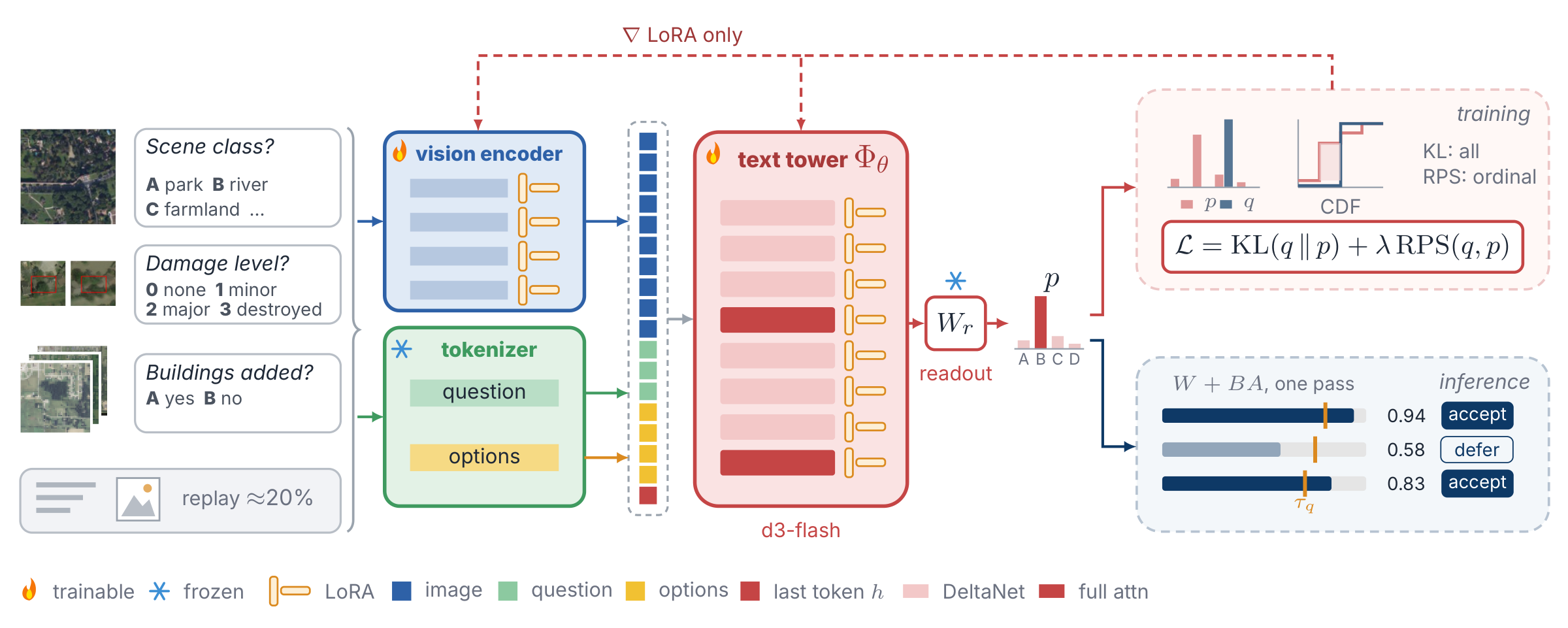
EO-Jev adapts the decision model d3-flash to Earth observation. In a single forward pass, it improves significantly on 26 of 30 settings, matches or beats the specialist reference on 20 of 28, and gains 8.0 points on settings held out from adaptation.

Abstract

Earth-observation workflows often require choosing among known outcomes with a trustworthy confidence, across large volumes of imagery. Decision models return probabilities over candidate answers in a single forward pass, without autoregressive decoding, but their accuracy, calibration and transfer across EO tasks remain insufficiently understood. Our diagnostic study of d3-flash on 30 settings from 23 public EO benchmarks finds that compositional reasoning transfers well and calibration beats its Qwen3.5-9B backbone on 24 settings, while counting, change quantification, damage grading and recognising absent objects remain weak. Low-rank adaptation on public training splits gives EO-Jev which, beyond its accuracy gains, has lower calibration error than the specialist references on 21 of 28 settings, at a cost of 1.8 points of general decision performance. Quantitative perception, option-order consistency and calibration under distribution shift remain open.

Demo

EO-Jev in under a minute

How EO-Jev decides in one pass, three real-world scenarios (disaster triage, change monitoring and image geo-verification), why adaptation works, and the headline results.

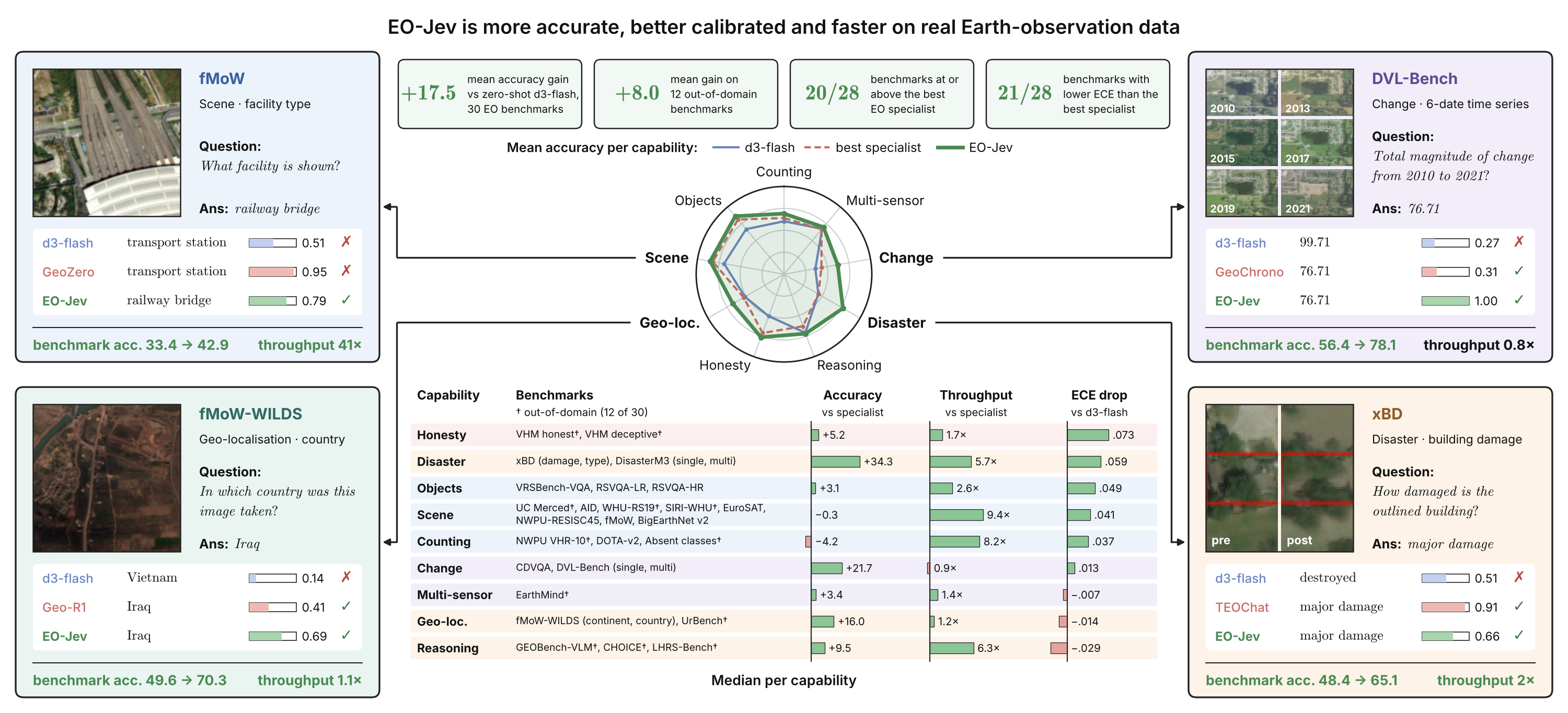
EO-Jev is more accurate, better calibrated and faster: a radar chart of mean accuracy per capability for d3-flash, the best specialist and EO-Jev; four example questions with each model's answer and confidence; and per-capability medians of accuracy gain, throughput and ECE drop.
EO-Jev is more accurate, better calibrated and faster. Centre: mean accuracy per capability (30 benchmarks). Corners: real questions with each model's answer and confidence; footers give benchmark accuracy (specialist → EO-Jev) and throughput vs. the specialist. Bottom: per-capability medians of accuracy gain and throughput vs. the best specialist, and ECE drop vs. d3-flash; green = better, red = worse.
Results

Explore the results

Every model answers identical questions. Pick a capability, sort any column, and open a row for its calibration and speed.

Lowest Highest, within each row I in-domain (dataset used in adaptation) O out-of-domain (held out from adaptation) Metric: accuracy; exact set on multi-select, strict on LHRS-Bench, abstention on VHM deceptive
Findings

Four questions, four answers

RQ1

Which EO capabilities transfer from a general-purpose decision model without EO-specific adaptation, and how does its performance compare with EO specialists?

77.5 vs 60.0LHRS-Bench: d3-flash against the best specialist

Compositional reasoning transfers and the probabilities are calibrated, but specialists lead wherever they trained on the benchmark.

RQ2

How does EO supervision affect performance, and do its benefits extend to datasets held out from adaptation?

+17.5points: mean gain over d3-flash across all 30 settings, in-domain (+23.8) and out-of-domain (+8.0)

Significant gains on 26 of 30 settings, and specialist level on 20 of 28 under equal supervision.

RQ3

How do calibration and inference cost compare with the backbone and specialist baselines?

21/28settings with lower calibration error than the best specialist

Lower ECE than d3-flash on 20 of 30 settings (significant on 17) and than its backbone on 27 of 30, and a median 6.4× the throughput of the best specialist (3.2× with one question per call).

RQ4

Which limitations persist after decision model adaptation to EO tasks?

90%of the specialist on NWPU VHR-10 counting, the lowest of 28 settings

Counting on unseen imagery, option-order robustness, cross-view geometry and calibration far from the training data.

The full analysis, with every table, figure and protocol detail, is in the paper on arXiv.

Beyond accuracy

Level, confidence and cost

Hover or tap a row for its numbers.

EO-Jev's score as a percentage of the best open EO specialist's. No setting falls below 85%.

Examples

EO-Jev against the other models

Real benchmark questions in four chapters, one example per capability. Every answer comes with the model's probability.

Citation

BibTeX

@article{abouelhadid2026eojev,
  title   = {{EO-Jev}: Decision Model for {Earth} Observation},
  author  = {Abouelhadid, Mohamed Atef and Abuhani, Diaa Addeen and
             Munir, Muhammad Akhtar and Khan, Fahad Shahbaz and Khan, Salman},
  journal = {arXiv preprint arXiv:2611.03371},
  year    = {2026}
}